Beef grading explained: What each USDA grade really means
Beef grading explained, two words that sound straightforward until you're standing at a meat counter, staring at a label that reads "USDA Choice" or "USDA Prime" and wondering what, exactly, you're paying for. You know the higher grade costs more. What the stamp actually guarantees is less obvious. So is whether the difference shows up on the plate, and whether upgrading is worth the money on a Tuesday night versus a special occasion cook.
Here's what most shoppers don't know: beef grading is actually a two-part system. One part predicts eating quality. The other tells processors how much usable meat a carcass will yield. These are separate evaluations, assigned separately, and only one of them typically shows up on a retail package. Understanding both changes how you read labels.
At 44 Farms, we work exclusively within the top two tiers of the USDA quality grade scale: Prime and Choice Black Angus. That means our team thinks about what those grades actually mean on a daily basis, from cattle genetics and feeding to the day a USDA grader evaluates our carcasses. This guide walks through the full system, from the very top of the scale down to grades that never see a retail case, so you can shop with real confidence.
Beef grading explained: quality grades vs. yield grades
The most common source of confusion in beef grading starts here: most people assume there is one grade when there are actually two entirely different evaluations happening on the same carcass. The USDA assigns them independently, and they measure completely different things.
What quality grades actually measure
Quality grades predict your eating experience. Specifically, they estimate tenderness, juiciness, and flavor before a single cut is fabricated. A trained USDA grader assigns this grade by evaluating visual traits on the carcass, with marbling as the primary factor. This is the grade that appears on your retail package and drives the buying decisions most home cooks actually make.
What yield grades tell the industry
Yield grades run on a scale of 1 through 5 and estimate how much closely trimmed, boneless retail meat a carcass will produce from the four main primals: round, loin, rib, and chuck. A Yield Grade 1 returns the most usable meat, more than 52.3% cutability, while a Yield Grade 5 returns the least, under 45.4%. These numbers matter enormously to packers and processors making purchasing decisions, but they rarely appear on retail packages in a way most consumers notice.
Why the distinction matters when you're buying
A carcass can carry a high quality grade while also carrying a lower yield grade, and this combination is actually common with heavily marbled Prime beef. More intramuscular fat means better eating quality but also more fat that gets trimmed before a cut reaches your pan. Knowing this prevents confusion when a butcher or online retailer uses yield terminology, and it helps you understand why Prime commands a price premium that goes beyond simple supply and demand.
The full USDA quality grade scale, from Prime to Canner
Most consumers can name three beef grades. The official USDA quality grade scale has eight. Here is the complete ladder, with a clear explanation of what each grade means for flavor, tenderness, and where it actually ends up.
Prime and Choice: the top two tiers
USDA Prime represents the highest eating quality available from young, well-fed cattle with abundant marbling. Prime typically accounts for around 10% of federally graded beef in the United States each year, which is why the majority goes to restaurants and specialty retailers rather than standard grocery chains. USDA Choice carries less marbling than Prime but still delivers excellent eating quality, and it represents the grade most serious home cooks encounter regularly. At 44 Farms, every cut we ship falls within one of these two grades, USDA Prime or Choice Black Angus, because these are the only tiers we consider worth cooking to a proper internal temperature and serving with pride.
Select, Standard, and Commercial: the middle of the scale
Select is leaner and more uniform than Choice, and it is widely available in mainstream supermarkets. It remains tender enough for quick-cooking methods on the right cuts, but it lacks the juiciness and depth of flavor that the top two grades deliver. Standard and Commercial grades are rarely labeled by grade in retail settings at all. Standard typically comes from young cattle with minimal marbling; Commercial comes from more mature cattle with the muscle structure and lean color that reflects that age. Both grades can be edible, but neither approaches the overall palatability of Select and above.
Utility, Cutter, and Canner: processing grades, not retail grades
The bottom three grades on the scale do not appear in any retail meat case. Utility, Cutter, and Canner grades describe beef destined for processed products: ground beef blends, canned goods, sausages, and institutional food service products. These grades come from older cattle or carcasses that simply did not meet the quality thresholds required for retail sale. Knowing they exist is useful because it clarifies the full scope of how beef enters the food supply and gives you a frame of reference for what "graded beef" actually means as a category distinction.
What drives a beef grade: marbling score, maturity, and carcass traits
The quality grade isn't assigned arbitrarily. There is a defined set of physical traits a grader evaluates, and understanding those traits explains why some ranches and some breeds consistently produce top-grade beef while others don't.
Why marbling score is the primary driver
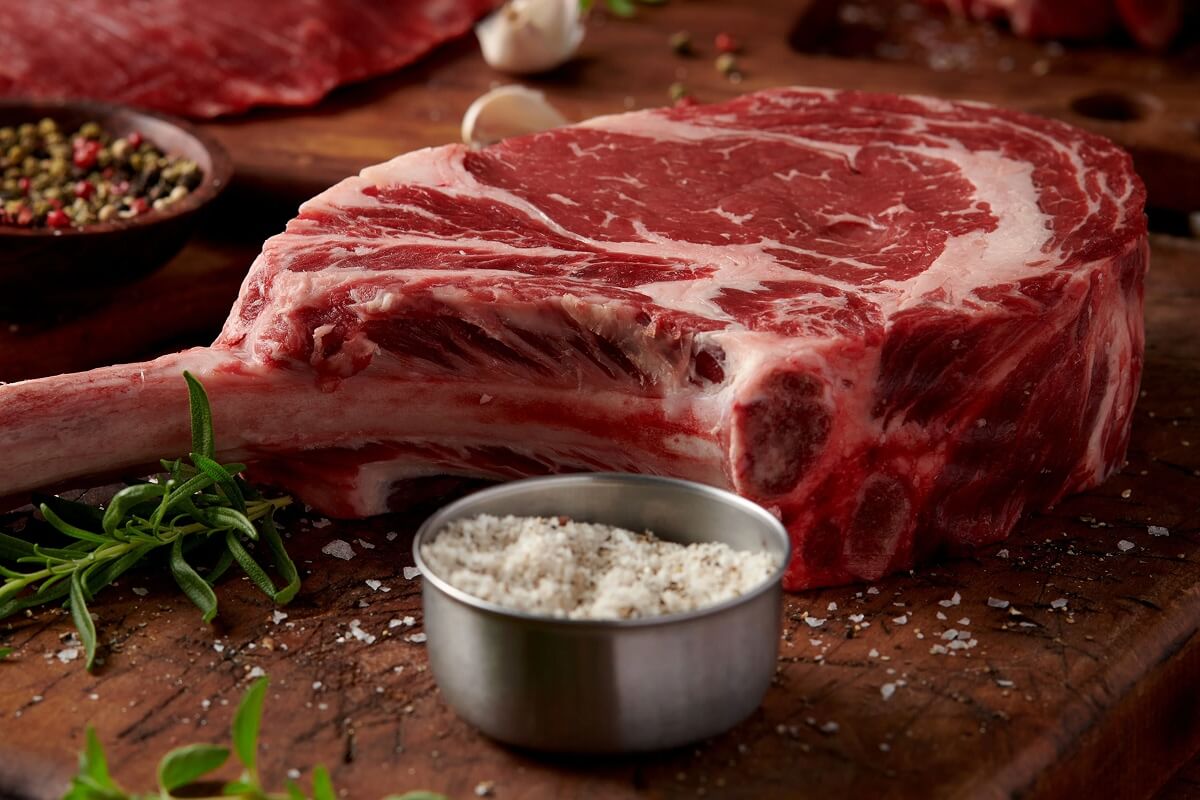
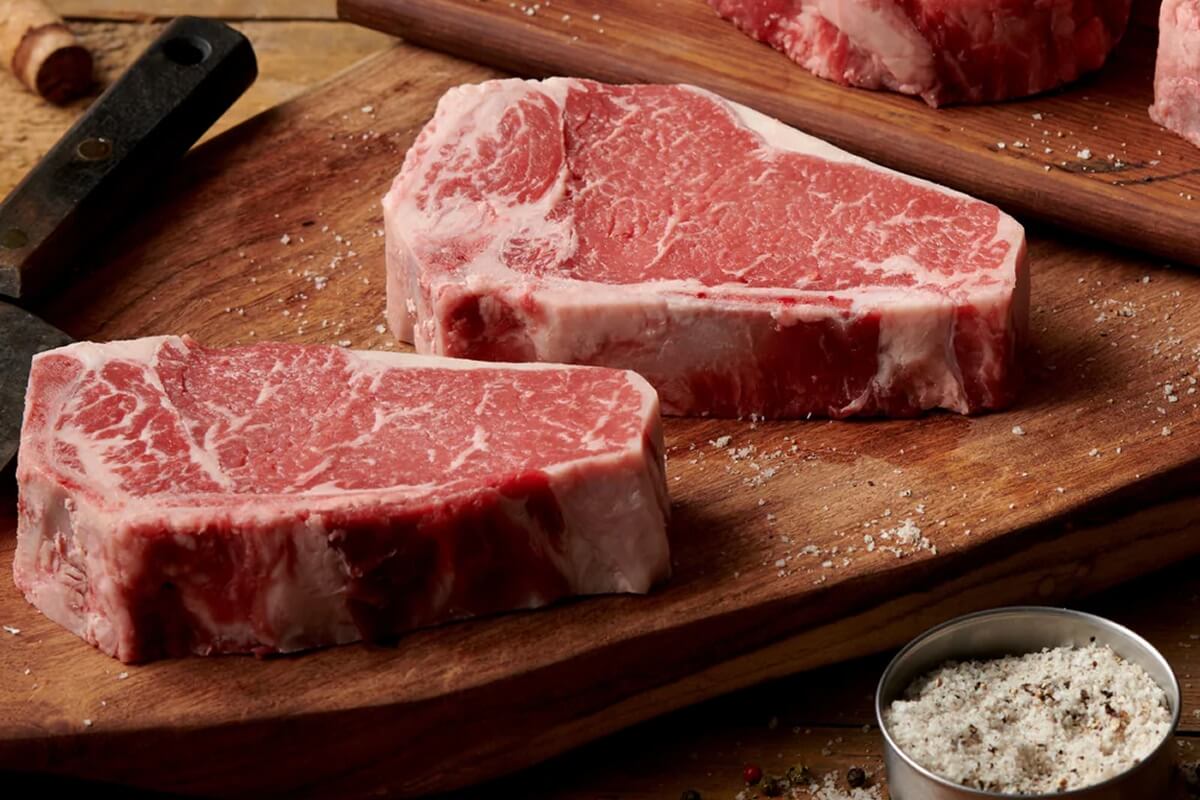
Marbling, the white speckling of intramuscular fat visible within the muscle, is the single strongest predictor of eating quality. The grader evaluates the exposed ribeye, cut between the 12th and 13th ribs, to assess the marbling score: the amount and distribution of that intramuscular fat. More marbling produces a better eating experience because it bastes the muscle fiber from within as it cooks. This is exactly why breeds developed for marbling potential, like registered Black Angus cattle, consistently dominate the upper quality grades.
How maturity, color, and texture factor in
Maturity is assessed through bone and cartilage ossification, the degree to which cartilage has converted to bone. Younger carcasses earn higher grades more readily because the muscle fiber structure supports better palatability. Lean color is also a meaningful signal; bright cherry-red lean indicates a younger, more desirable carcass, while dark lean suggests advanced maturity and typically correlates with a lower quality grade. Texture and firmness round out the evaluation, with fine-textured lean preferred over coarse, which again tends to accompany increased maturity.
What graders actually look at in practice
Carcass grading happens before fabrication into individual cuts begins. After chilling for roughly 18 to 48 hours post-harvest, a trained USDA Agricultural Marketing Service grader evaluates the exposed rib section. Modern facilities also use camera-based and remote grading systems, where images captured at the plant are reviewed by a remote grader to determine the official quality grade. The grader stamps the carcass once the grade is assigned, and that determination follows every cut fabricated from that carcass.
How the USDA grading process works
Knowing that grades exist is one thing. Understanding who assigns them, when, and how those grade shields reach the package you pick up gives the system its credibility, and explains why the USDA mark means something specific.
Who grades beef and when grading happens
USDA beef grading is a voluntary, fee-based service requested and paid for by the packer or processor. A USDA Agricultural Marketing Service grader, working independently of both the producer and the packer, performs the evaluation. Grading takes place after slaughter and chilling, before the carcass is broken down into primals and retail cuts. That independence is what makes the official grade credible.
How grade shields and labels reach the retail package
Once a grade is assigned, the carcass is stamped with the official USDA grade mark. When cuts are fabricated from that carcass, the retail package can legally display the familiar USDA shield. Those grade shields, printed with the grade name, signal that an official grader made the determination, not the producer and not the processor. If a product was not officially graded, the packer cannot legally display the USDA shield, which makes the presence of that mark a meaningful signal rather than a marketing claim.
Why grading is separate from inspection
USDA inspection is mandatory and covers wholesomeness and food safety. Every piece of beef sold commercially in the United States has been inspected. Grading is separate, voluntary, and covers eating quality. Not every piece of commercially sold beef has been officially graded. This distinction matters when you're evaluating product claims on packaging: inspection confirms the beef is safe, while the grade shield confirms an independent evaluation of eating quality actually took place.
Choosing the right grade for your cooking method and budget
All of that grading knowledge only matters if it helps you make a better decision at the point of purchase. Here is how to match grade to cooking method and occasion without overthinking it.
When Prime is worth the price premium
Prime beef performs best in high-heat, dry cooking environments: grilling over direct fire, searing hard in cast iron, or broiling. The abundant marbling bastes the muscle from within as it cooks, producing the juiciness and concentrated flavor that make the price premium feel justified. If you are cooking a ribeye for a celebration, hosting a dinner you want to remember, or trying to replicate a great steakhouse experience at home, Prime is the grade that delivers on those expectations.
Choice as the everyday high-performance grade
Choice covers a meaningful range within its tier, from lower Choice that sits closer to Select in marbling all the way up to upper Choice that approaches Prime quality. Buying upper Choice from a breed-specific source like registered Black Angus closes that gap with Prime considerably. For most grilled steaks, roasts, and backyard cooking situations, upper Choice delivers excellent results at a more accessible price point, especially when you know the source and the breed behind it.
When Select makes sense and how to cook it
Select earns its place when you plan to braise, marinate, or use a low-and-slow moist-heat method. The leaner profile works against it in a high-heat sear, but a Select chuck roast braised for several hours or a marinated flank steak handled correctly is still a satisfying, well-cooked meal. The key is matching the grade to the method rather than treating all grades as interchangeable cuts of the same product.
How beef grading differs outside the United States
If you've ever browsed a specialty butcher or ordered from an international supplier, you've likely encountered grade labels that don't map directly onto the USDA system. Canada has its own framework, and understanding the broad differences saves confusion when those labels appear.
Canada's A/AA/AAA/Prime system
Canada uses letter grades for its top quality tiers: A, AA, AAA, and Prime. Like the USDA system, Canadian grading evaluates marbling, maturity, and lean color. The Canadian Beef Grading Agency distinguishes AA from AAA primarily on marbling: AAA requires at least a small amount of marbling, while AA requires at least slight marbling but less than small. Industry buyers commonly treat Canadian AAA as roughly equivalent to upper USDA Choice, though this is informal shorthand rather than an official equivalency.
Why US and Canadian grades aren't directly interchangeable
The evaluation frameworks differ enough that assuming a Canadian AAA equals a USDA Choice cut is an oversimplification. The US system carries a broader official scale of eight quality grades compared to Canada's four main consumer-facing grades, and the specific thresholds and criteria differ between the two systems. For American consumers buying domestic beef, the USDA scale is the practical priority. When cross-border comparisons come up at a specialty butcher or on a product page, knowing the Canadian framework keeps you from treating the two systems as identical.
Beef grading explained: what the grade on your package actually tells you
Beef grading is a two-part system where quality grades predict your eating experience and yield grades tell processors how much usable meat to expect from a carcass. For retail buyers, only the quality grade matters directly: the scale runs from Prime through Canner, but Prime, Choice, and Select are the only three tiers relevant to what you cook at home. The marbling score drives the quality grade more than any other single factor, which is why breed selection and feeding practices matter so much at the ranch level, long before a USDA grader ever shows up at the facility.
When you see the USDA Prime or Choice shield on a package, you know an independent, trained grader assigned that grade based on real carcass evaluation. That shield is not a marketing claim. It is a documented assessment from a third party with no financial stake in the outcome. At 44 Farms, working exclusively within those top two tiers is a deliberate commitment, one that starts with registered Black Angus genetics on our Cameron, Texas ranch, well before grading day arrives.
Now that you have beef grading explained from the ground up, you can put that knowledge to work. Explore our full selection of USDA Prime and Choice Black Angus cuts at 44 Farms, from ribeyes evaluated at the 12th-rib section by an independent USDA grader, to briskets and curated bundles built for every cook on the calendar. Every product ships directly from our ranch to your door with the provenance and grade transparency you now know how to read.